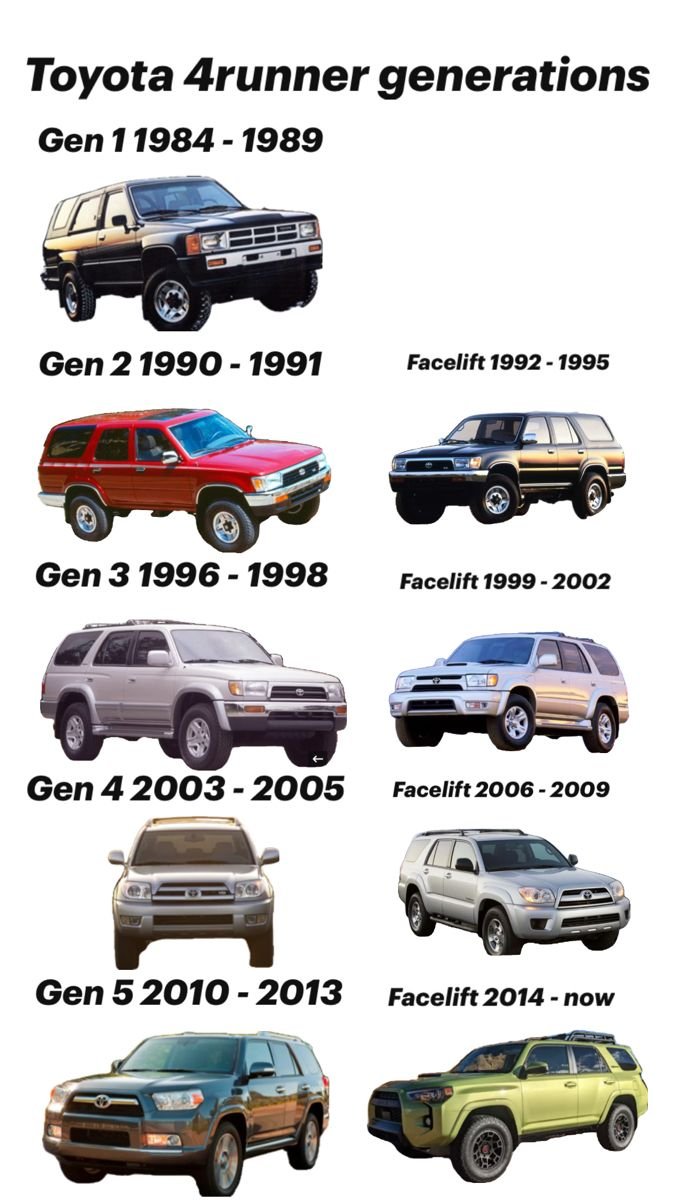
The Toyota 4Runner isn't just an SUV; it's a legend. For nearly four decades, this rugged vehicle has carved out a unique niche, bridging the gap between utilitarian toughness and everyday adventure. From its humble beginnings as a modified pickup to its latest iteration, the 4Runner has consistently adapted while staying true to its off-road heritage. Before the 4Runner even officially debuted, a precursor emerged in the form of the 1981-1983 Toyota Trekker, a Hilux pickup converted into an SUV by Winnebago, setting the stage for what was to come.
Unpacking the 4Runner's Enduring Legacy
Embark with us on a journey through time, exploring how each generation built upon the last, evolving in design, capability, and technology. Understanding these shifts helps us appreciate the enduring appeal of this iconic SUV. If you're eager to get a broad understanding of how this SUV has changed over the years, you'll want to Discover 4Runner generations and features for a quick dive into its defining characteristics.
The Genesis: Early Years and the First Generation (N60, 1984-1989)
The 1st Generation 4Runner officially launched in 1984, establishing the nameplate as an in-house designed SUV directly derived from the Hilux pickup. This generation set a precedent with its rugged, no-nonsense approach, famously offering a Bronco-like removable rear fiberglass canopy or hardtop. This unique feature made it the only 4Runner generation to provide an open-air driving experience from the factory. Under the hood, early models came with the robust 22R 2.4L inline four-cylinder engine, available in carbureted, fuel-injected, and even turbocharged versions. By 1987, a 3.0L V6 option became available, enabled by a significant update to independent front suspension in 1986.
Evolving into a Dedicated SUV: The Second Generation (N130, 1990-1995)
The 2nd Generation marked a pivotal shift for the 4Runner. It was the first time the vehicle was solely developed as an SUV, boasting a proper all-steel body rather than a converted pickup. This brought significant advancements in refinement and safety. Distinctively, this generation also introduced a factory-available swing-out rear bumper, a practical touch that wouldn't be seen again. While primarily a four-door, the two-door body style was offered for a few years before being dropped after a mild facelift for the 1992 model year. Interestingly, it featured an oversized rear window, a design cue that recently made a comeback with the 6th Generation.
The Golden Age of Reliability: The Third Generation (N180, 1996-2002)
Often heralded as a high point by enthusiasts, the 3rd Generation debuted as an entirely new model, moving firmly upmarket. It shared its robust platform with the legendary J90 Land Cruiser Prado, signaling a commitment to serious capability. This era saw a significant leap in refinement and power, sharing many parts, including its durable 3.4L V6 engine, with the 1st Gen Toyota Tacoma. The N180 is famously renowned for its bulletproof reliability, with countless units still on the road today having clocked well over 300,000 miles. A noticeable facelift improved its aesthetics for the 1999 model year. If you're curious about which specific powertrains defined these early legends, you'll find a detailed breakdown when you Explore 4Runner engine evolution.
Power and Progression: The Fourth Generation (N210, 2003-2009)
Building on the success of its predecessor, the 4th Generation continued its evolution, again based on a formidable platform: the Prado 120. This generation brought a major milestone to the 4Runner lineage: the introduction of a V8 engine option, borrowed from the Tundra, alongside a powerful standard V6. This was the first, and so far only, time a V8 graced the 4Runner's engine bay. The 4.0L V6, while generally strong, saw a modification in late 2005 with a redesigned head gasket to proactively address a known persistent failure issue, demonstrating Toyota's commitment to continuous improvement. A stylistic facelift was applied in 2006, keeping its appearance fresh. For those keen on understanding the common ailments or celebrated strong suits across different models, it's wise to Explore 4Runner reliability trends.
The Long Reign: The Fifth Generation (N280, 2010-2024)
The 5th Generation holds the title for the longest-running generation, maintaining its presence for a remarkable 14 years. During this extensive run, it solidified its position as one of the most popular 4Runner iterations since the beloved 3rd Gen. Sharing its highly capable platform with the J150 Prado, Lexus GX, and the now-classic Toyota FJ Cruiser, this generation continued the tradition of robust, body-on-frame construction. The V8 engine option was sadly dropped, and by the 2011 model year, the smaller 2.7L four-cylinder was also discontinued, leaving the venerable 4.0L 1GR V6 as the sole, unyielding engine choice for over a decade. Facelifts in 2013 and a more significant one in 2014 updated its exterior styling, headlights, and interior, ensuring its continued appeal while the core V6 engine soldiered on unchanged. This generation, in particular, honed the vehicle's reputation for tackling tough terrain. To really appreciate how the 4Runner became such an off-road icon, you should Explore 4Runners off-road capabilities.
A New Chapter: The Sixth Generation (2025-Present)
The automotive world eagerly welcomed the latest iteration for the 2025 model year, ushering in the 6th Generation 4Runner with significant and modernizing changes. Built on Toyota's highly versatile TNGA-F platform, which it now shares with the modern Tacoma, Tundra, and Sequoia, this new 4Runner marks its closest relation to the Tacoma since the 3rd Gen. Perhaps the most notable update under the hood is the shift to an all-new turbo 4-cylinder engine, now the only available option, signifying a clear move towards more efficient, yet still powerful, performance. This generation aims to blend traditional ruggedness with contemporary technology and efficiency, ready for the next era of adventure.
Finding Your Perfect Adventure Machine
Each generation of the Toyota 4Runner offers a distinct blend of history, capability, and character. Whether you're drawn to the vintage charm of a first-gen, the legendary reliability of a third-gen, or the cutting-edge features of the upcoming sixth-gen, there's a 4Runner out there for every enthusiast and adventurer. With such a rich lineage, understanding the nuances of each model year is key to making an informed decision. For a comprehensive guide tailored to help you make this important choice, we recommend you Choosing the right 4Runner generation.
The Unfolding Journey of an Icon
The Toyota 4Runner’s journey through six distinct generations is a testament to its foundational strength and Toyota's commitment to continuous evolution. It’s a vehicle that consistently delivers on its promise of durability, versatility, and off-road prowess, ensuring its legacy will continue for many more years to come. As the 6th Generation hits the road, it carries forward a torch passed down through decades, ready to write its own chapter in the annals of automotive adventure.